The Partnership sends updates for the most important economic indicators each month. If you would like to opt-in to receive these updates, please click here.
Estimated Reading Time: 2 minutes.
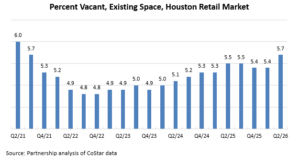
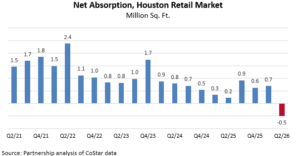
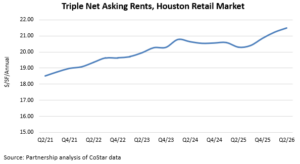
Houston’s retail market remained relatively stable in Q2/26, despite modest softening in several indicators. The vacancy rate increased to 5.7 percent, and the market recorded 509,089 square feet of negative net absorption. Leasing activity moderated from the prior quarter, while average asking rent increased to a record $21.49 per square foot. Construction activity eased to approximately 4.2 million square feet underway.
Vacancy increased from 5.4 percent in Q1/26 and 5.5 percent in Q2/25. Although the Q2 rate was the highest in nearly five years, it remains below the levels recorded during the early stages of the pandemic and within a relatively narrow historical range. Continued population and job growth remain supportive of retail demand, even as retailers take a more measured approach to adding space.
The market posted 509,089 square feet of negative net absorption in Q2/26, following a prolonged period of positive quarterly absorption. Losses were concentrated in several submarkets, including the Inner Loop, while other areas continued to record positive absorption. The quarterly decline was influenced by larger move-outs and uneven activity across the region and does not necessarily indicate a broad-based pullback in tenant demand.
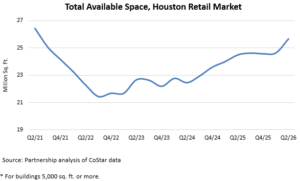
At the end of Q2/26, total available retail space—including vacant space, occupied space being marketed for lease, sublease space, and space expected to become available—totaled 25.6 million square feet, up from 24.5 million square feet one year earlier.
Retail rents continued to increase in Q2/26, although the pace of growth remained moderate. The average triple net asking rent reached a record $21.49 per square foot, up from $21.23 in the prior quarter and $20.30 one year earlier. Under a triple net lease, tenants generally pay property taxes, insurance, and maintenance expenses in addition to base rent. The continued increase suggests that asking rents remain firm despite softer absorption and a modest rise in vacancy.
Prepared by Greater Houston Partnership Research
Leta Wauson, Research Director