Key Takeaways
Here are the facts to know about the Houston region this month
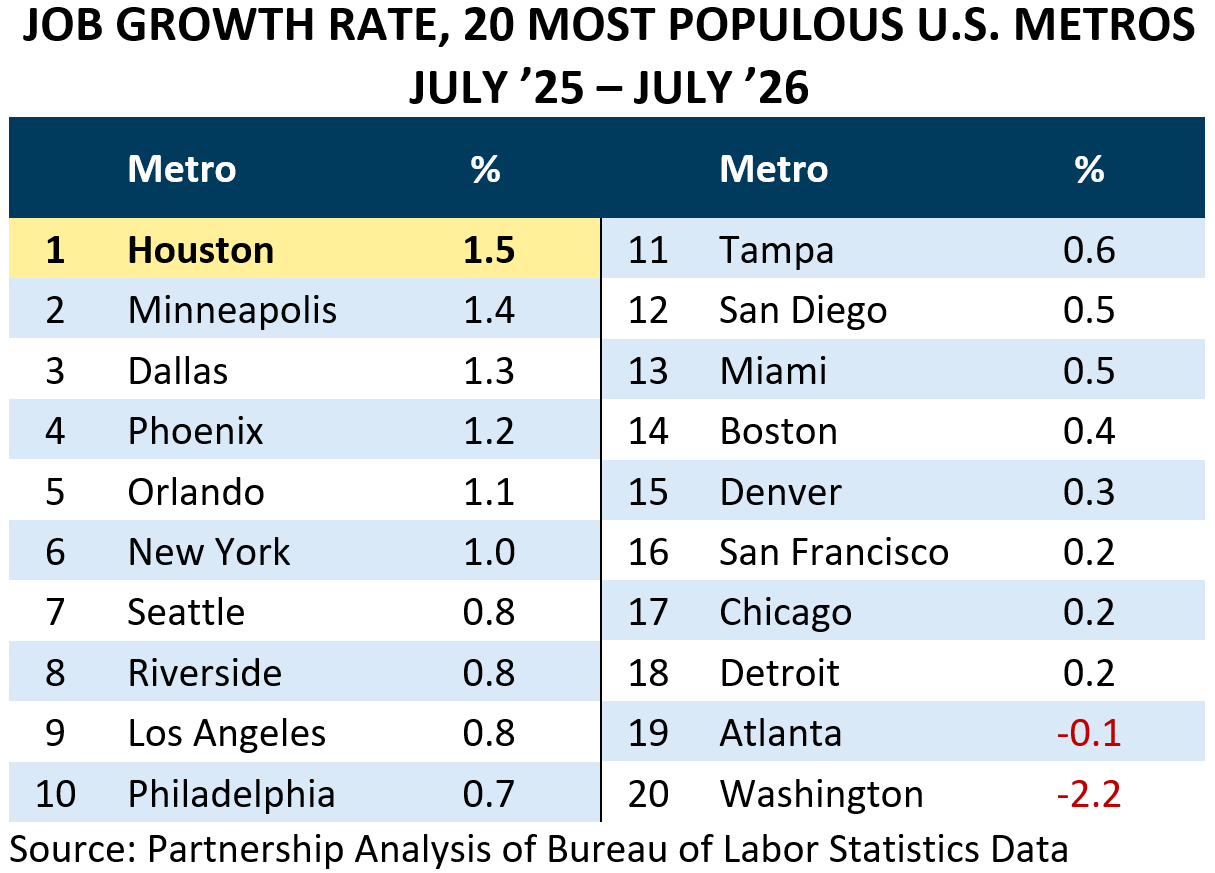
#1 - The number of jobs in Houston grew by 1.5 percent over the past 12 months, roughly six times the national rate and faster than any other major U.S. metro.
#2 - Exports surged 26.2 percent, driven largely by oil and liquid fuels, while Port Houston’s containerized trade is also on pace for a record year.
#3 - Home and vehicle sales remain resilient, while nominal sales tax collections continue to grow, pointing to solid consumer demand despite higher borrowing costs.
Economic Update
Through the first half of the year, Houston’s economy has shown renewed momentum after a slower ’25. The strongest signal is the labor market, where Houston’s job base is growing at roughly six times the national pace and faster than any of the nation’s major metros. Business conditions have also improved since the start of the year, exports have surged, and home and vehicle sales remain resilient.
There are still areas to watch. Durable goods manufacturing has been uneven, construction awards have eased from last year’s record, and unemployment remains slightly elevated. Even so, the broader mix of indicators suggests Houston is entering the final quarter of ’26 with firmer momentum than much of the country.
Employment
Metro Houston added 50,300 jobs in the 12 months ending July ’26, bringing total nonfarm employment in the region to 3,497,700. That represents a significant rebound from the unusually soft pace of job growth in calendar year ’25, when the region added just 17,500 jobs.
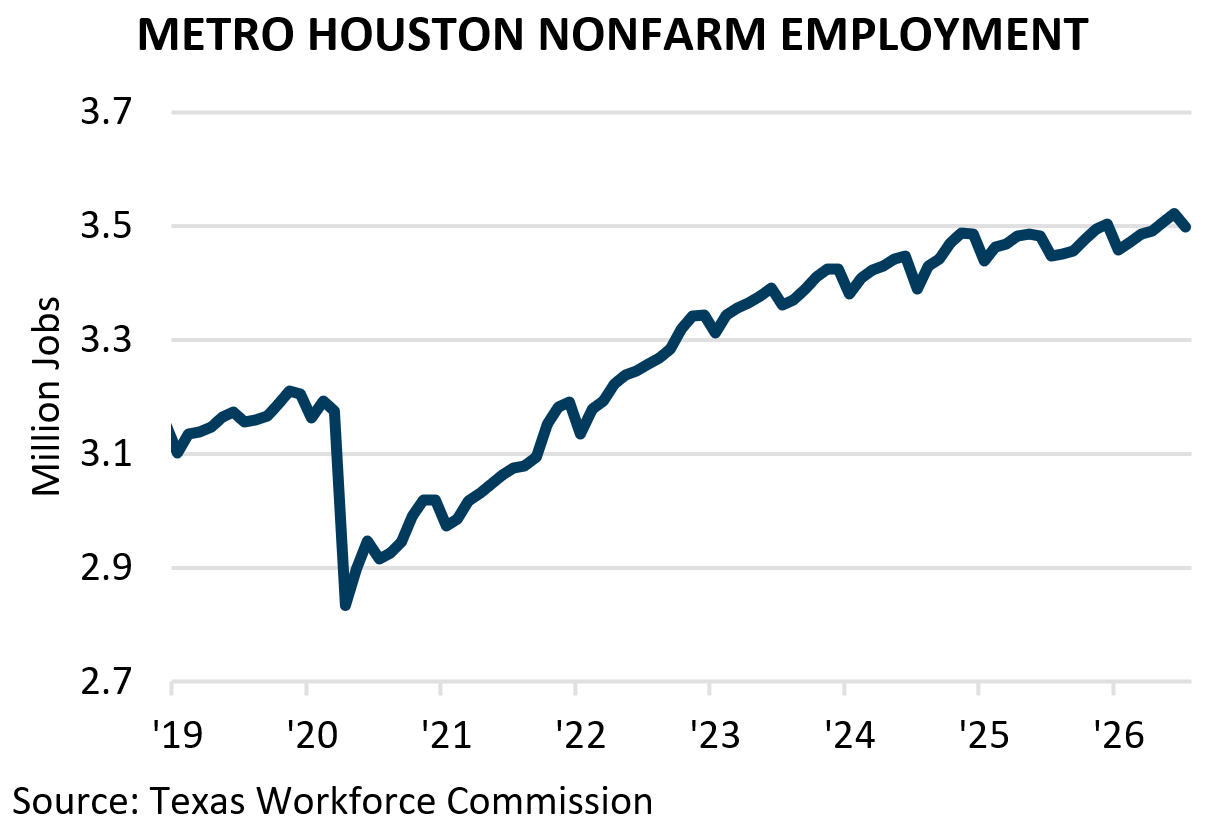
Houston’s year-over-year job growth is now approaching the pace one might expect in a more typical year. Some of that apparent strength, however, reflects a soft baseline. July ’25 saw an unusually large seasonal drop in education jobs, which makes the latest year-over-year comparison somewhat stronger.
Houston’s improvement comes at a time when the national labor market is also showing signs of stabilizing. The U.S. ended ’25 with just 69,000 jobs created over the entire year, reflecting a 0.04 percent job growth rate. But as of July ’26, year-over-year growth has improved to 382,000 jobs or a 0.2 percent growth rate.
But Houston’s gains have been considerably stronger. The region’s 50,300 new jobs represent a 1.5 percent growth rate, roughly six times the national rate. That was the fastest pace among the nation’s 20 most populous metros.
Construction and administrative support tied for the top spot in year-over-year job growth, together accounting for just over half of all jobs added. Construction hiring tied to major infrastructure projects has cooled from last year’s surge, but growth has shifted toward building and specialty trade contractors. Growth in administrative support was concentrated in employment services, where stronger energy-related activity appears to be supporting demand for temporary workers.
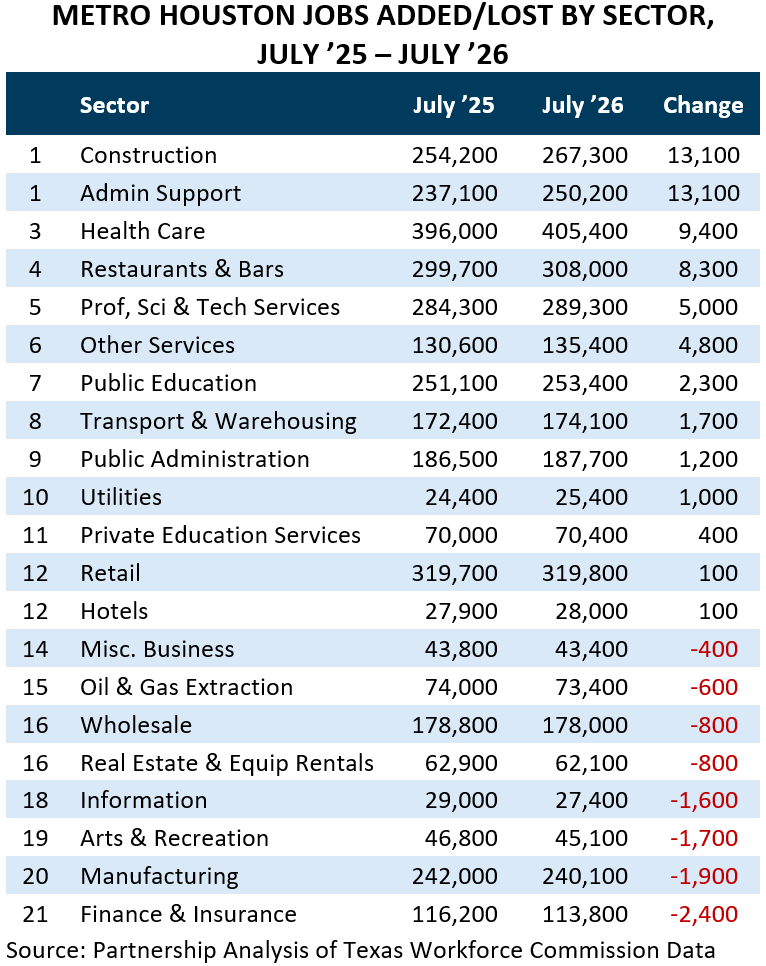
Health care and social assistance also posted solid gains, along with restaurants and bars, consistent with the needs of Houston’s growing population. Professional, scientific and technical services added 5,000 positions as business-to-business spending picked up after a slower ’25. Much of that spending appears concentrated in the energy sector, where the closure of the Strait of Hormuz and resulting spike in global oil prices have strengthened the prospects for new exploration and drilling. That set of events has increased demand for engineering, technical and other professional services tied to activity in the Permian Basin, even as drilling remains relatively stable.
Eight of the 21 sectors tracked by the Partnership lost jobs over the year, though the declines were generally modest, with no sector shedding more than 2,500 positions. Finance and insurance posted the largest decline, mirroring a national trend that partly reflects elevated mortgage rates, industry consolidation and ongoing efforts to improve efficiency.
Unemployment
Houston’s unemployment rate stood at 5.1 percent in July, somewhat higher than the levels seen in recent years but still well below the pandemic-era highs of 6 to 13 percent experienced between ’20 and ’21.
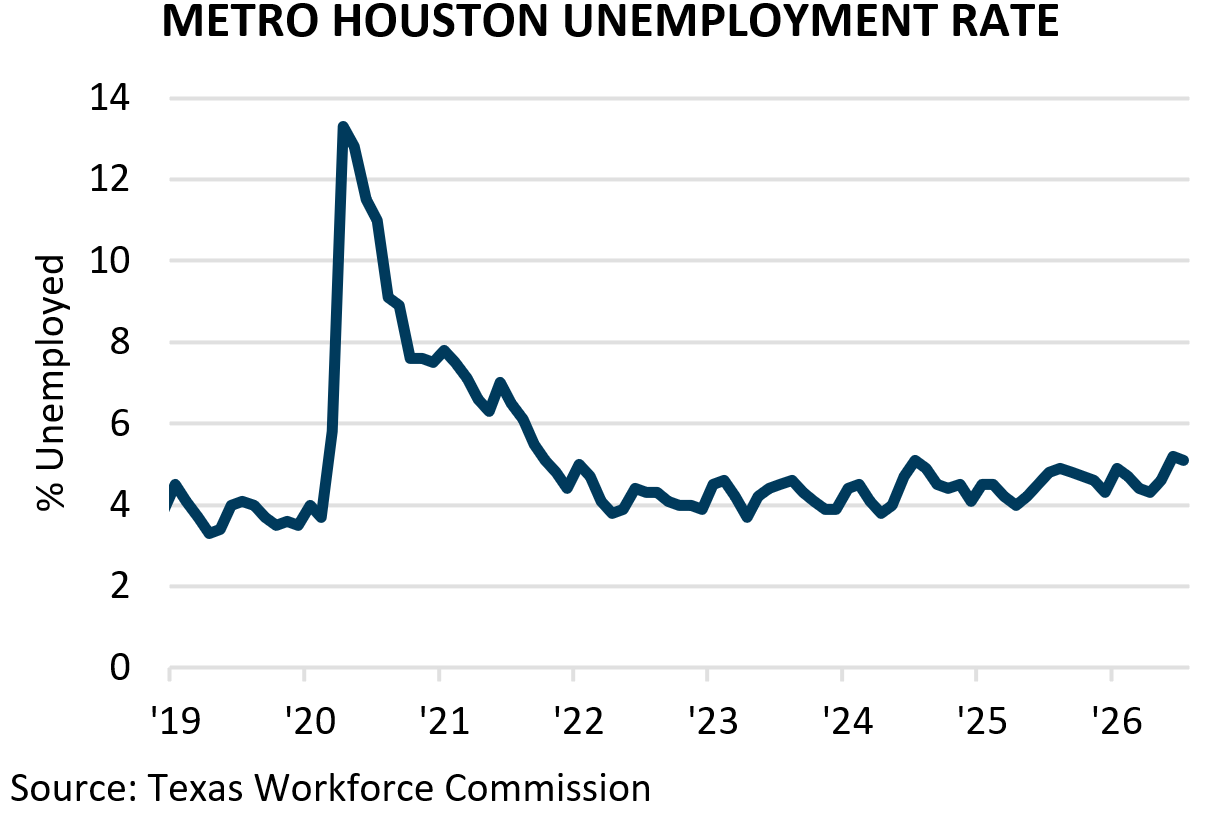
The rate has generally run above both the statewide and national averages in recent years. The gap partly reflects Houston’s younger, faster-growing labor force, which continues to add recent graduates and other new job seekers at a faster pace than they can find work.
The rise in the unemployment rate does not appear to be driven by an increase in layoffs. Initial claims for unemployment benefits, a useful proxy for layoffs, have declined modestly from roughly 4,500 per week in late August ’25 to around 4,000 in the most recent readings.
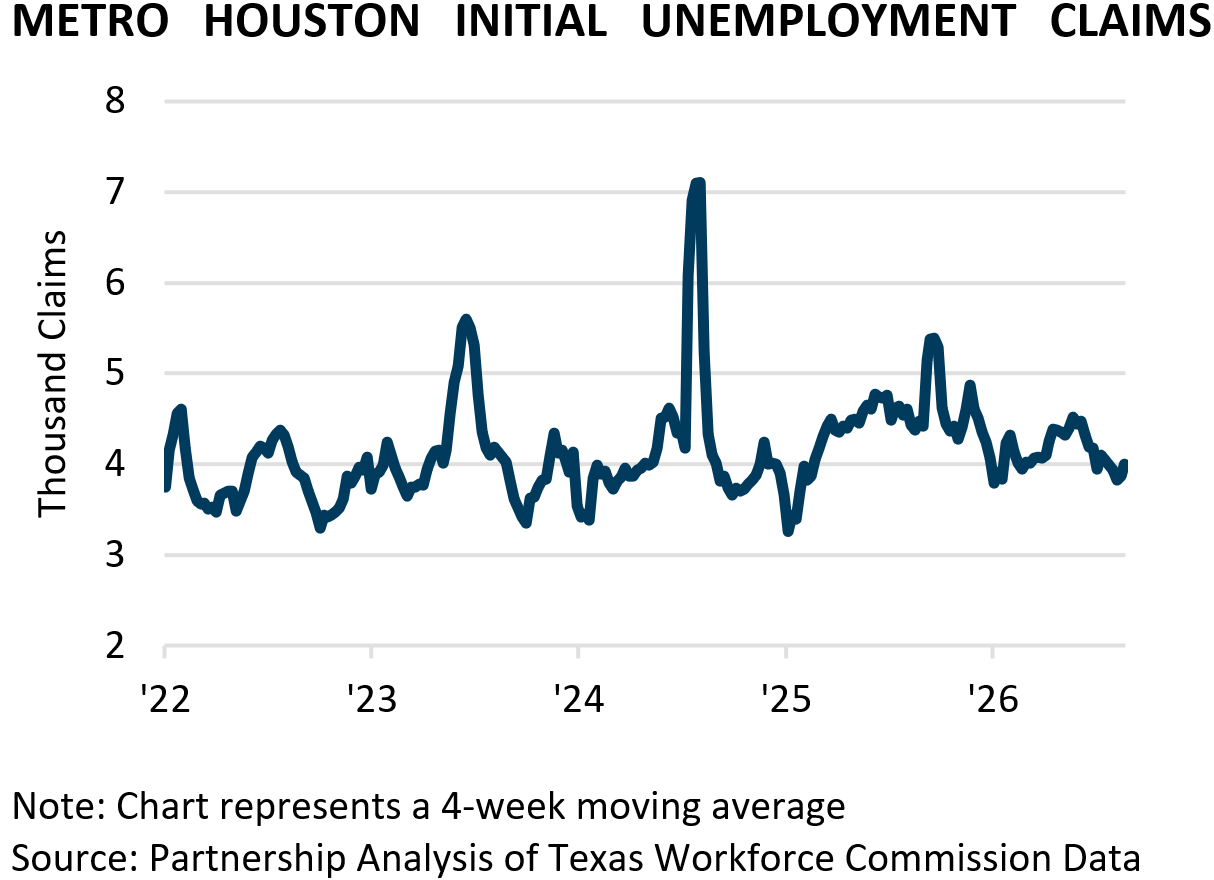
The combination of fewer claims and a higher unemployment rate suggests more of the increase is coming from a growing pool of job seekers taking longer to find work, rather than from a broad rise in job losses.
Note: The geographic area referred to in this publication as “Houston,” "Houston Area” and “Metro Houston” is the ten-county Census designated metropolitan statistical area of Houston-Pasadena-The Woodlands-Sugar Land, TX. The ten counties are: Austin, Brazoria, Chambers, Fort Bend, Galveston, Harris, Liberty, Montgomery, San Jacinto, and Waller.
To continue reading, please download the full report below: