Key Takeaways
Here are the facts to know about the Houston region this month
Takeaway #1
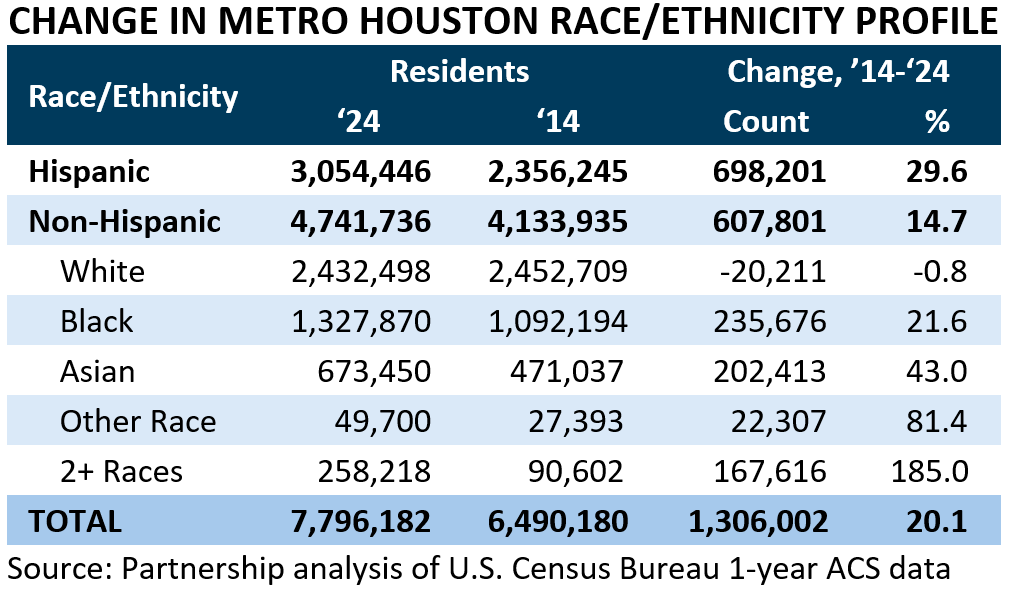
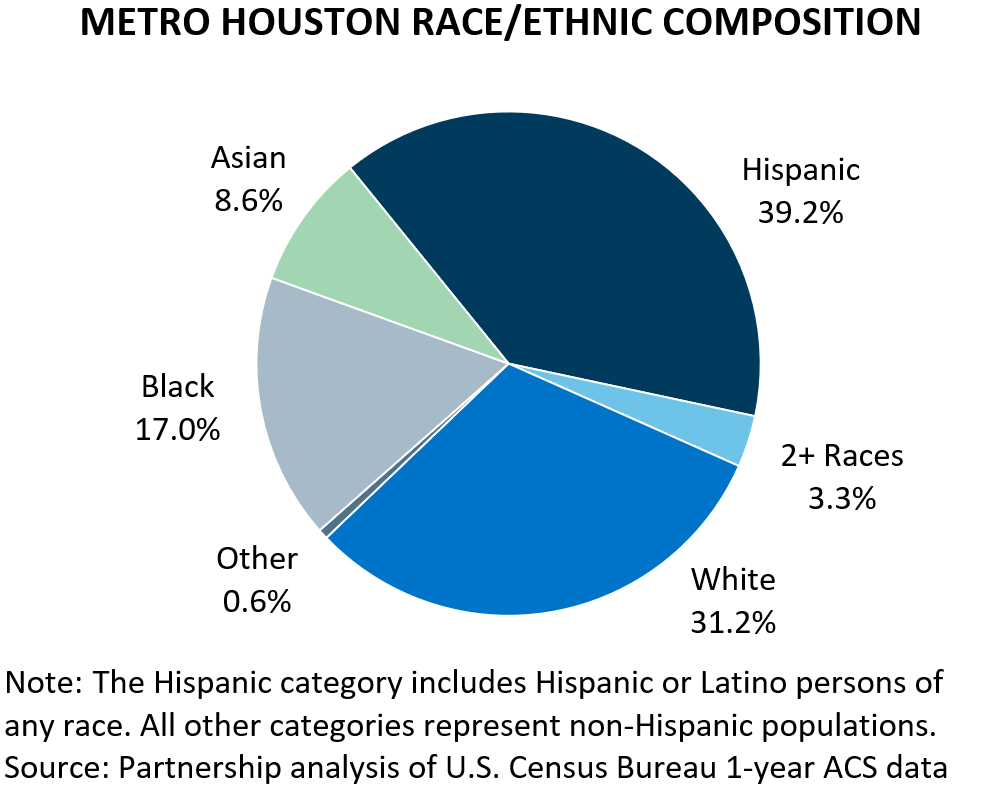
Metro Houston has become more diverse in terms of race/ethnicity. Hispanic along with non-Hispanic Black and Asian residents make up a growing share of the population, but no single group constitutes a majority.
Takeaway #2
The region is younger than the nation overall and has added over a quarter of a million residents under the age of 20 over the past 10 years.
Takeaway #3
More Houstonians are pursuing higher levels of education, with almost two-thirds having some experience with college, and almost half holding an associate’s degree or higher.
WHO WE ARE
Each fall, the U.S. Census Bureau releases new American Community Survey (ACS) estimates, showing how the nation’s demographic, social, economic, and housing characteristics have changed relative to the previous year. The ‘24 data, released in September, includes estimates for Houston and other major metro areas. In this issue of Glance, the Partnership examines some of the ways the region has changed over the past decade. Subsequent editions of Glance will look at the same ACS data in greater detail, comparing Houston to its peer metropolitan areas.
Race and Ethnicity
Houston, already one of the nation’s most ethnically and racially diverse metros, has grown even more diverse over the past decade. Since ‘14, the region’s Hispanic or Latino population has increased by nearly 700,000, while non-Hispanic Black and Asian populations have added over 200,000 residents each. The non-Hispanic white population has declined slightly, though part of this change may be due to the growing number of residents who now identify with more than one race—a group that has nearly tripled during the same period.
Hispanic or Latino residents make up the largest racial/ethnic group in the region, followed closely by non-Hispanic white residents. But, as has been the case since the late ‘90s, no single group constitutes a majority.
Age
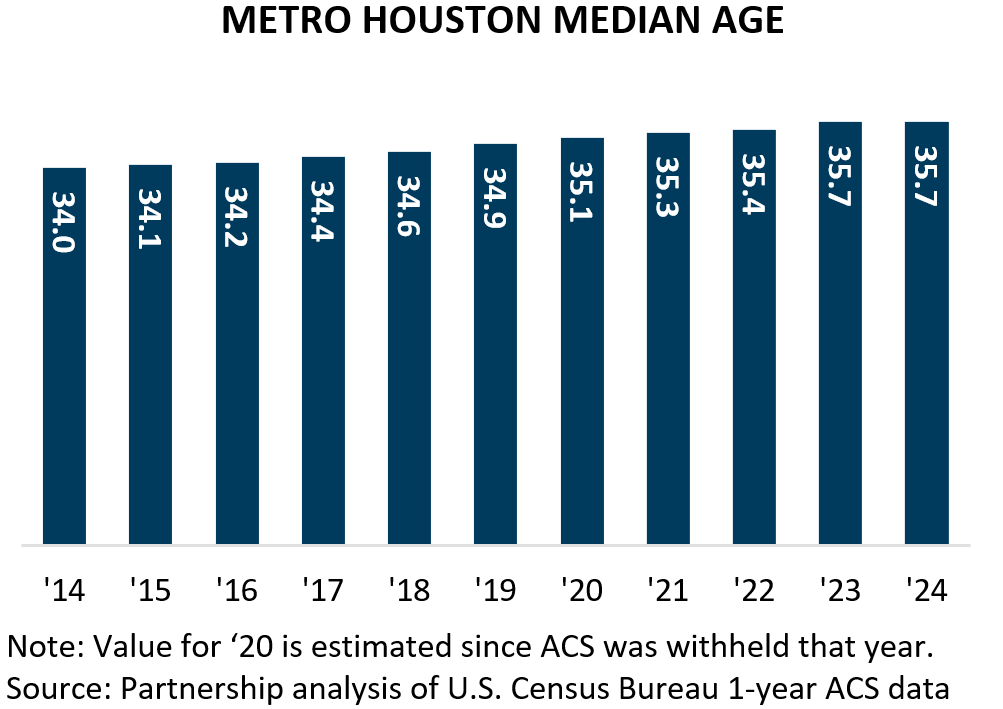
Houston continues to be younger than the nation as a whole, with a median age of 35.7 years old compared to the U.S. median of 39.1. The region’s population is aging, but at a gradual pace. The median age has increased by one year and eight months since ’14 – but it held steady between ’23 and ‘24.
Improved healthcare technology and declines in harmful behaviors such as smoking have extended life expectancies and helped expand Houston’s senior population. A decade ago, residents aged 65 and older made up about 1 in 10 Houstonians, but last year they accounted for roughly 1 in 8.
Note: The geographic area referred to in this publication as “Houston,” "Houston Area” and “Metro Houston” is the ten-county Census designated metropolitan statistical area of Houston-Pasadena-The Woodlands-Sugar Land, TX. The ten counties are: Austin, Brazoria, Chambers, Fort Bend, Galveston, Harris, Liberty, Montgomery, San Jacinto, and Waller.
To continue reading, please download the full report below: