Key Takeaways
Here are the facts to know about the Houston region this month
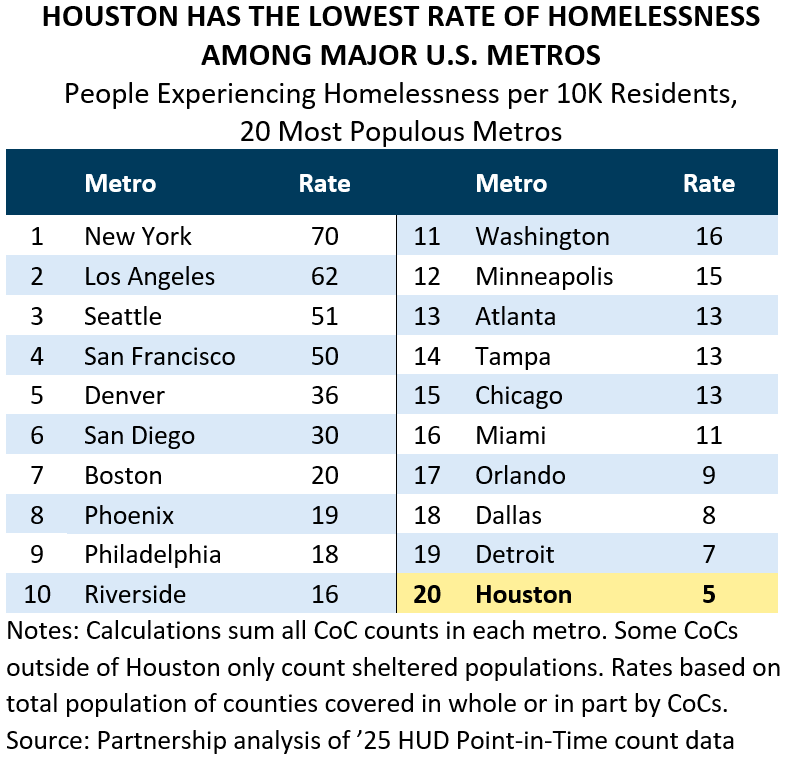
#1 - Houston has the lowest rate of homelessness among major U.S. metros, with about five people experiencing homelessness per 10,000 residents.
#2 - Houston-area students in grades 3–8 outperformed statewide averages by 1.6 percentage points in reading and 2.7 points in math on the '26 STAAR test.
#3 - Barbers Hill, Friendswood and Tomball ISD rank among the region’s top-performing school districts, while Hempstead, Spring Branch, Needville, and Houston ISD have posted some of the largest gains since the pandemic.
HOMELESSNESS IN HOUSTON
On a single night every winter, the various regional organizations charged with caring for local homeless populations fan out across shelters, streets and encampments to count the nation’s unhoused residents. Known as Continuums of Care (CoCs), these organizations conduct the count within their service areas on behalf of the U.S. Department of Housing and Urban Development (HUD), to provide the official snapshot of homelessness in the U.S.
The latest local count, conducted by the Coalition for the Homeless of Houston/Harris County, found approximately 3,325 people experiencing homelessness across Fort Bend, Harris, and Montgomery counties. Representing a region of 6.8 million people, that amounts to five people experiencing homelessness for every 10,000 residents – the lowest rate among the nation’s major U.S. metros.
Homelessness remains a serious hardship for every person who experiences it, and Houston’s low rate does not make the issue any less urgent. But it does place the region in a very different position than most of its peers.
The contrast is especially stark when comparing against major metros on the coasts. The rate of homelessness is roughly 14 times higher in New York, 12 times higher in Los Angeles, and 10 times higher in Seattle and San Francisco.
Houston’s most recent result is not a fluke. For more than a decade, the region has pushed homelessness sharply lower, helped by a relatively affordable housing market and more coordination on policy interventions. Since ’11, the local rate has fallen by more than two-thirds, from 16 residents per 10,000 to just five today. The national trend has moved in the opposite direction since the pandemic, with U.S. homelessness now near a record high with 22 people experiencing homelessness per 10,000 residents.
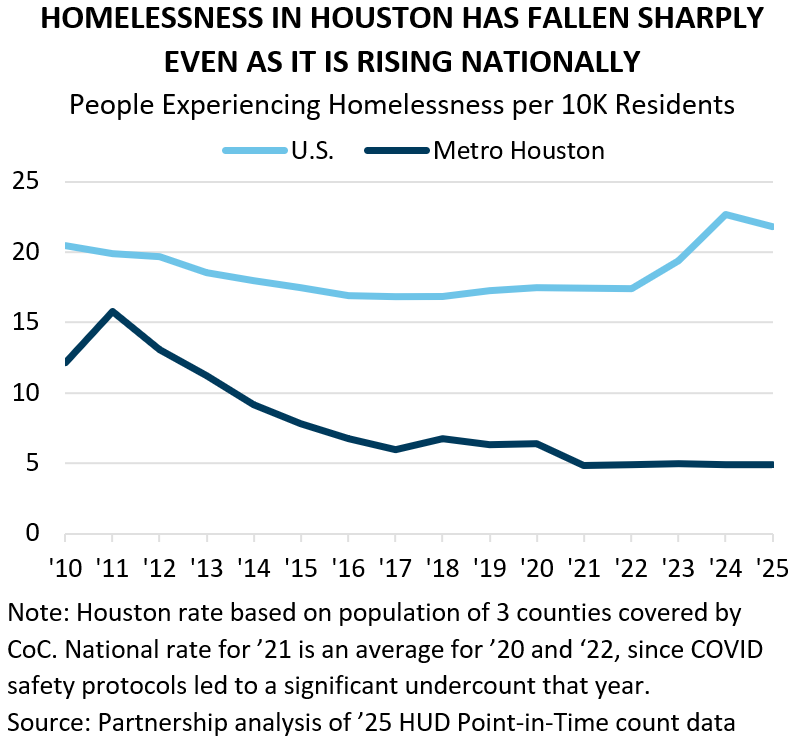
After falling through much of the ’10s, the national homelessness rate began climbing in ’22 as inflation pushed housing costs sharply higher and pandemic-era protections and support programs started to fade.
But Houston bucked that trend. While Hurricane Harvey and the long tail of the fracking bust may have nudged the local rate slightly higher from ’17 to ’20, it declined during the pandemic and remained stable in the years since.
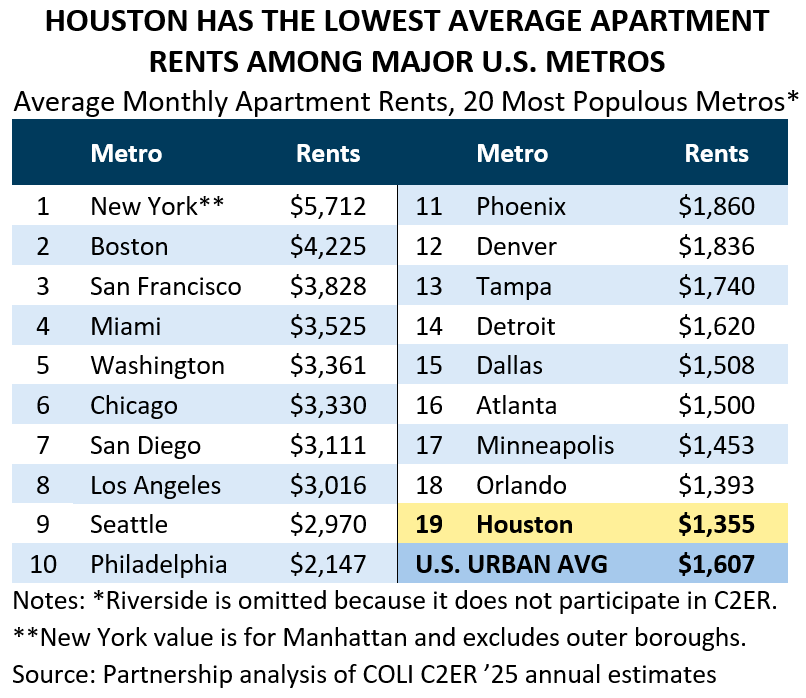
Houston’s housing market gave the region an important advantage. Among the nation’s 20 largest metros, Houston has the lowest average monthly apartment rent at $1,355, below Dallas, Atlanta and the U.S. urban average. The gap is much wider compared with high-cost coastal metros. Average rents in New York, Boston, San Francisco, Miami and Washington are more than double Houston’s, and in some cases three or four times higher. That does not mean housing is easy to afford for Houston’s lowest-income residents. But it does mean fewer households are pushed to the edge by rent alone, and each housing dollar can reach further than it would in many peer regions.
Another factor behind Houston’s success is the coordinated housing-first strategy the region began to adopt in ’12. Through The Way Home, the region’s CoC, local partner organizations prioritized permanent housing first, with support services provided to residents once they were housed.
Note: The geographic area referred to in this publication as “Houston,” "Houston Area” and “Metro Houston” is the ten-county Census designated metropolitan statistical area of Houston-Pasadena-The Woodlands-Sugar Land, TX. The ten counties are: Austin, Brazoria, Chambers, Fort Bend, Galveston, Harris, Liberty, Montgomery, San Jacinto, and Waller.
To continue reading, please download the full report below: